Wind farms are a major undertaking that use up a lot of space. Sometimes, offshore wind is the solution.
In this article, Energy Digital looks at the top 10 offshore wind farms by sheer generating capacity.
SOURCE:
http://www.energydigital.com/renewables/3804/Top-10-Offshore-Wind-Farms-in-the-World
10. Lincs - U.K., 270 MW
Located off the east coast of England, the Lincs Wind Farm is a £1 billion wind farm owned by Centrica, DONG Energy, and Siemens. The project began in 2004, though was only completed in 2013. A notable inclusion in the project is the extensive underground cable system that runs electricity back to land. This comprised 25 percent of the project’s cost and will outlast the 40 year lifespan of the project itself.
9. Meerwind Süd/Ost - Germany, 288 MW
The Meerwind wind farms are two separate wind farms (south and east) located in the German Bright of the North Sea. The farms only opened in September of last year and are owned by WindMW. The location of the project is particularly notable for its location, which boats a stellar combination of strong winds a convenient water depth. The farm also uses the nearby island of Helgoland as its maintenance base.
8. Thanet - U.K., 300 MW
The Thanet wind farm is off the southeastern cost of Kent in the U.K. When it was completed in 2010, it was set to be the largest operational wind farm in the world. Judging as how it’s now number eight on the list, that is no longer the case. Still, the Thanet project uses state-of-the-art Vestas turbines and is owned by Vattenfall.
7. Sheringham Shoal - U.K., 317 MW
If you haven’t figured it out by now, the U.K. is a major world leader in offshore wind energy and Sheringham Shoal is one of the country’s most iconic projects. The turbines are huge—so big, a double-decker bus could drive through one. Ownership of the project is split 50-50 between Statoil and Statkraft. The estimated actual output of the project is around 125 MW, which is sufficient to power approximately 220,000 average UK homes, more than twice the equivalent electricity required to supply the whole of the North Norfolk coast.
6. Thorntonbank - Belgium, 325 MW
Stationed off the north coast of Belgium, this farm recently reached its maximum planned capacity of 325 MW. The project was completed in three phases, with the most recently being finished in September of 2013. It currently has 54 operational units and cost an estimated £1.3 billion to complete. It was designed to have a minimum environmental impact to both sea life and shipping routes.
5. Walney - U.K., 367 MW
Located in the Irish Sea, the Walney Wind Farm is in a little shallower waters than some of the others on this list in only 19-23m waters. The project is a partnership between DONG Energy and Scottish and Southern Energy. DONG was awarded a 50-year lease for the project and completed the construction in two phases. The wind warm saw a small crisis earlier this year when a dive vessel crashed into one of the turbines and spilled a small amount of oil into a sea.
4. BARD Offshore 1 - Germany, 400 MW
The BARD Offshore 1 wind farm is also relatively new, as it was only completed in September of 2013. Owned by Enovos, the farm sits off the north coast of Germany. The project is noteworthy for its use of the Wind Lift 1 barge during its construction, which placed the massive, 470 ton, 21 meter foundations into the seabed.
3. Anholt - Denmark, 400 MW
The largest offshore wind farm in Denmark, Anholt was also only completed in September of 2013. A project of DONG Energy, the wind farm cost roughly 10 billion Danish kroner to build. This project is unique in its placement of the Siemens turbines. Usually, turbines are placed in a grid pattern of lines and rows, though that’s not the case with Anholt. The turbines placed in an unusual pattern, governed by two principles: put most of them along the edges, and put most in undisturbed airflow from the main direction, which is West-southwest—increasing production by 1.5%, a lifetime value of more than 100m Danish kroner.
2. Greater Gabbard - U.K., 504 MW
The Greater Gabbard wind farm started out as a project between Airtricity and Fluor, though through mergers, acquisitions and other moves, it is currently owned by Scottish and Southern Energy. It was finished in 2012, though there is ongoing work on the underwater cables for the project. The project will also undergo expansion, adding 140 turbines by 2017.
1. London Array - U.K., 630
The London Array is the king of the offshore wind farm. The project has multiple owners and has seen a huge investment of £1.8 billion. Located near the southwest coast of England, the project is a sight to behold. The array is intended to reduce annual CO2 emissions by roughly 900,000 tons—equal to the emissions of 300,000 passenger cars.
London Array Offshore Wind Farm from Aarsleff on Vimeo.
Britain’s oldest nuclear plant closed on Wednesday, leaving in its wake a £700m decommissioning bill and further questions about the UK’s ability to keep the lights on.
The closure of the Wylfa plant in Wales after 44 years of service puts more pressure on EDF Energy to take a final investment decision for new reactors at Hinkley in Somerset.
The station on the island of Anglesey generated enough electricity to power 1m homes, and with a capacity of 1,000MW was once the largest facility of its kind in the world. But after an earlier life extension scheme expired, the last of the 26 British-designed Magnox reactors was switched off by the private consortium that manages the plant for the Nuclear Decommissioning Authority (NDA).
The site was due to close in 2010 but it was kept open for a further five years as fears mounted that Britain would face an electricity shortage because new atomic and gas-fired power plants were not being constructed. “Wylfa has been a terrific success story for Anglesey and the UK nuclear industry. We have generated safely and securely for many years, which is an excellent achievement,” said Stuart Law, the site director.
It will take another 10 years for the basic decommissioning to be undertaken at a cost of about £700m but the site cannot be redeveloped before the end of the century. High-level waste from Wylfa will remain on Anglesey until a national nuclear waste disposal facility is finally developed.
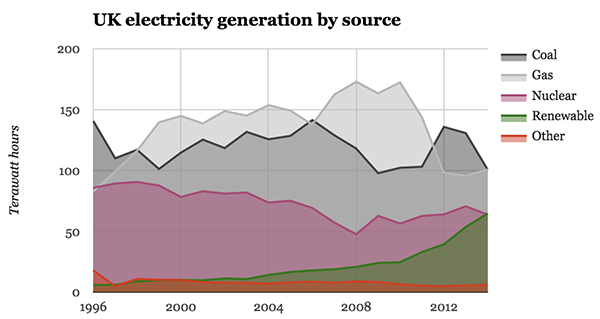
Britain still has a fleet of advanced cooled atomic reactors run by EDF but most of these will be retired by 2023 just as the government has also promised to halt all coal-fired power stations.
Hitachi of Japan is leading a Horizon Nuclear Power project to construct a new power plant at Wylfa, with a second earmarked for Oldbury in south Gloucestershire alongside a third facility planned in Cumbria. But the atomic industry’s revived fortunes ride primarily on the Hinkley C plant, which is expected to be the first new site since the Sizewell B station was completed in 1995.
The £18bn Somerset project has been repeatedly delayed but Chinese investors finally gave their support in the autumn while the government promised the latest in a series of subsidies. EDF signalled in October that it would start work at Hinkley and it is expected to give the formal investment the go ahead within weeks before later saying it may not come until after Christmas.
Hinkley Point C, intended to provide about 7% of the UK’s total electricity, was originally scheduled for completion by 2018 but the latest date is 2025. Sceptics still question whether it will make that later date given the experiences of delays and cost overruns with a similar power project at Flamanville in Normandy, northern France.
There have also been problems at the new Olkiluoto nuclear plant in Finland which is using the same plant design provided by EDF’s engineering partner Areva at Flamanville and planned for Hinkley.
National Grid, Britain’s electricity network operator, has played down the significance of the Wylfa closure and says it has put special measures in place to meet any mid-winter peaks in power demand. Another milestone in the change of Britain from a high to a lower carbon energy producer came two weeks ago when the country’s last deep coal mine, at Kellingley in North Yorkshire, closed.
SOURCE: http://www.theguardian.com/environment/2015/dec/30/wylfa-nuclear-plant-closes-in-wales
The closure of the Wylfa plant in Wales after 44 years of service puts more pressure on EDF Energy to take a final investment decision for new reactors at Hinkley in Somerset.
The station on the island of Anglesey generated enough electricity to power 1m homes, and with a capacity of 1,000MW was once the largest facility of its kind in the world. But after an earlier life extension scheme expired, the last of the 26 British-designed Magnox reactors was switched off by the private consortium that manages the plant for the Nuclear Decommissioning Authority (NDA).
The site was due to close in 2010 but it was kept open for a further five years as fears mounted that Britain would face an electricity shortage because new atomic and gas-fired power plants were not being constructed. “Wylfa has been a terrific success story for Anglesey and the UK nuclear industry. We have generated safely and securely for many years, which is an excellent achievement,” said Stuart Law, the site director.
It will take another 10 years for the basic decommissioning to be undertaken at a cost of about £700m but the site cannot be redeveloped before the end of the century. High-level waste from Wylfa will remain on Anglesey until a national nuclear waste disposal facility is finally developed.
Britain still has a fleet of advanced cooled atomic reactors run by EDF but most of these will be retired by 2023 just as the government has also promised to halt all coal-fired power stations.
Hitachi of Japan is leading a Horizon Nuclear Power project to construct a new power plant at Wylfa, with a second earmarked for Oldbury in south Gloucestershire alongside a third facility planned in Cumbria. But the atomic industry’s revived fortunes ride primarily on the Hinkley C plant, which is expected to be the first new site since the Sizewell B station was completed in 1995.
The £18bn Somerset project has been repeatedly delayed but Chinese investors finally gave their support in the autumn while the government promised the latest in a series of subsidies. EDF signalled in October that it would start work at Hinkley and it is expected to give the formal investment the go ahead within weeks before later saying it may not come until after Christmas.
Hinkley Point C, intended to provide about 7% of the UK’s total electricity, was originally scheduled for completion by 2018 but the latest date is 2025. Sceptics still question whether it will make that later date given the experiences of delays and cost overruns with a similar power project at Flamanville in Normandy, northern France.
There have also been problems at the new Olkiluoto nuclear plant in Finland which is using the same plant design provided by EDF’s engineering partner Areva at Flamanville and planned for Hinkley.
National Grid, Britain’s electricity network operator, has played down the significance of the Wylfa closure and says it has put special measures in place to meet any mid-winter peaks in power demand. Another milestone in the change of Britain from a high to a lower carbon energy producer came two weeks ago when the country’s last deep coal mine, at Kellingley in North Yorkshire, closed.
SOURCE: http://www.theguardian.com/environment/2015/dec/30/wylfa-nuclear-plant-closes-in-wales