Showing posts with label Energy. Show all posts

Jan 14, 2016

Britain opens world's largest offshore wind farm

Prime Minister David Cameron hails the London Array wind farm "a great win for Kent, a great win for renewable energy and a great win for Britain".

Source: http://www.telegraph.co.uk/news/earth/energy/renewableenergy/10159719/Britain-opens-worlds-largest-offshore-wind-farm.html

 2:33PM BST 04 Jul 2013


Top 10 Offshore Wind Farms in the World

Wind farms are a major undertaking that use up a lot of space. Sometimes, offshore wind is the solution.
In this article, Energy Digital looks at the top 10 offshore wind farms by sheer generating capacity.

SOURCE:
http://www.energydigital.com/renewables/3804/Top-10-Offshore-Wind-Farms-in-the-World


10. Lincs - U.K., 270 MW

Located off the east coast of England, the Lincs Wind Farm is a £1 billion wind farm owned by Centrica, DONG Energy, and Siemens. The project began in 2004, though was only completed in 2013. A notable inclusion in the project is the extensive underground cable system that runs electricity back to land. This comprised 25 percent of the project’s cost and will outlast the 40 year lifespan of the project itself.

9. Meerwind Süd/Ost - Germany, 288 MW

The Meerwind wind farms are two separate wind farms (south and east) located in the German Bright of the North Sea. The farms only opened in September of last year and are owned by WindMW. The location of the project is particularly notable for its location, which boats a stellar combination of strong winds a convenient water depth. The farm also uses the nearby island of Helgoland as its maintenance base.

8. Thanet - U.K., 300 MW

The Thanet wind farm is off the southeastern cost of Kent in the U.K. When it was completed in 2010, it was set to be the largest operational wind farm in the world. Judging as how it’s now number eight on the list, that is no longer the case. Still, the Thanet project uses state-of-the-art Vestas turbines and is owned by Vattenfall.

7. Sheringham Shoal - U.K., 317 MW

If you haven’t figured it out by now, the U.K. is a major world leader in offshore wind energy and Sheringham Shoal is one of the country’s most iconic projects. The turbines are huge—so big, a double-decker bus could drive through one. Ownership of the project is split 50-50 between Statoil and Statkraft. The estimated actual output of the project is around 125 MW, which is sufficient to power approximately 220,000 average UK homes, more than twice the equivalent electricity required to supply the whole of the North Norfolk coast.

6. Thorntonbank - Belgium, 325 MW

Stationed off the north coast of Belgium, this farm recently reached its maximum planned capacity of 325 MW. The project was completed in three phases, with the most recently being finished in September of 2013. It currently has 54 operational units and cost an estimated £1.3 billion to complete. It was designed to have a minimum environmental impact to both sea life and shipping routes.
5. Walney - U.K., 367 MW
Located in the Irish Sea, the Walney Wind Farm is in a little shallower waters than some of the others on this list in only 19-23m waters. The project is a partnership between DONG Energy and Scottish and Southern Energy. DONG was awarded a 50-year lease for the project and completed the construction in two phases. The wind warm saw a small crisis earlier this year when a dive vessel crashed into one of the turbines and spilled a small amount of oil into a sea.

4. BARD Offshore 1 - Germany, 400 MW

The BARD Offshore 1 wind farm is also relatively new, as it was only completed in September of 2013. Owned by Enovos, the farm sits off the north coast of Germany. The project is noteworthy for its use of the Wind Lift 1 barge during its construction, which placed the massive, 470 ton, 21 meter foundations into the seabed.

3. Anholt - Denmark, 400 MW

The largest offshore wind farm in Denmark, Anholt was also only completed in September of 2013. A project of DONG Energy, the wind farm cost roughly 10 billion Danish kroner to build. This project is unique in its placement of the Siemens turbines. Usually, turbines are placed in a grid pattern of lines and rows, though that’s not the case with Anholt. The turbines placed in an unusual pattern, governed by two principles: put most of them along the edges, and put most in undisturbed airflow from the main direction, which is West-southwest—increasing production by 1.5%, a lifetime value of more than 100m Danish kroner.

2. Greater Gabbard - U.K., 504 MW

The Greater Gabbard wind farm started out as a project between Airtricity and Fluor, though through mergers, acquisitions and other moves, it is currently owned by Scottish and Southern Energy. It was finished in 2012, though there is ongoing work on the underwater cables for the project. The project will also undergo expansion, adding 140 turbines by 2017.

1. London Array - U.K., 630

The London Array is the king of the offshore wind farm. The project has multiple owners and has seen a huge investment of £1.8 billion. Located near the southwest coast of England, the project is a sight to behold. The array is intended to reduce annual CO2 emissions by roughly 900,000 tons—equal to the emissions of 300,000 passenger cars.


London Array Offshore Wind Farm from Aarsleff on Vimeo.

Jan 8, 2016

Climate of change / COP21

December 16th 2015 | Multiple countries | Alternatives
 
Late on Saturday, December 12th, delegates representing over 190 countries at the Paris climate conference formally adopted the Paris Agreement, which will set the tone for international action to tackle climate change. The agreement reinstates a global consensus on the need for broader action to reduce greenhouse gas emissions, among both developed and developing economies, and provides an agreed framework for increasingly ambitious future action. 

The outcome of the Paris conference in itself will not solve the problem of climate change—it was never intended to—but the trajectory towards more interventionist policies aimed at reducing emissions could become irreversible as a result of it. What is less certain, however, in part because the agreement does not include specific targets on emissions reduction, is the pace at which countries will move along that trajectory. This will ultimately be decided by policymakers at the national level, but they will be operating in an environment where the actions of countries will come under increasing scrutiny at both global and national levels.

The agreement is a potential catalyst for more substantive action to reduce the carbon intensity of the global economy. Given that over the past few years there have been noticeable shifts in the attitudes of key nations, such as the US and China, towards reducing emissions, we believe that the Paris Agreement will facilitate meaningful action at a global level over the longer term.

The features of the agreement

The Paris Agreement will "come into force" once at least 55 countries covering at least 55% of emissions have signed up to it: the US, China and the EU alone will be virtually enough to clear the emissions hurdle, making ratification highly likely, as the wording of the text means that the US president, Barack Obama, can approve it without going to Congress. It allows for considerable flexibility among countries to determine how they will contribute to realising the overarching goal of placing a limit on the global average temperature increase. For example, there is no specific emissions-cutting target that is required for nations to adopt, nor a requirement to introduce a specific policy such as a carbon-pricing scheme, although market-based mechanisms are likely to play a more prominent role. The strength of the agreement, however, is that it facilitates a framework where countries will be encouraged, on the basis of ongoing review, to deliver on meeting emissions-reduction targets that are expected to become more ambitious over time. 

The highlights of the Paris Agreement are:
  • To hold the increase in the global average temperature to well below 2°C above pre-industrial levels. This is a more ambitious objective than in previous international agreements on climate change. Furthermore, in a concession to small island states and other highly vulnerable states, the text also includes an aspiration to limit the temperature increase to 1.5°C.
  • To aim to reach global peaking of greenhouse gas emissions as soon as possible, while recognising that peaking will take longer for developing countries. While no target year has been set for this emissions peak, there is a long-term commitment to "achieve a balance between anthropogenic emissions by sources and removals by sinks of greenhouse gases in the second half of this century". This effectively translates into a goal of net zero emissions to be achieved at some point beyond 2050.
  • To put in place an ongoing framework that will encourage countries to communicate and update their climate policy targets, in the form of intended nationally determined contributions (INDCs), on a regular five-yearly basis. The agreement establishes a framework of five-yearly "stocktakes" of progress made on climate policies from 2018, and these in turn will form the basis of submissions to be made by countries to strengthen their commitments to reduce emissions. These periodic national commitments are to be submitted every five years from 2020. The agreement therefore sets in motion a framework for an ongoing review of strategies to strengthen emissions reduction commitments over time.
  • To guarantee continued and enhanced climate finance from the developed world to assist developing countries to adopt a lower emissions pathway and build climate resilience into their economies. A target of US$100bn is to be provided annually by 2020, with a floor of US$100bn in annual finance to be pledged by 2025, although delivered assistance is likely to be less than the amount pledged.

What the agreement means

The paths that countries must take to try to reach these goals are not prescribed. The agreement calls on countries to submit progressively stronger commitments, but there is no specific emissions reduction target for countries to reach by a certain year (although many, such as the US and EU countries, have targets in place anyway). This will be facilitated through a collective (but largely voluntary) framework that seeks to reach a peak in emissions and to limit the global temperature increase to below 2°C. While the specific national targets of earlier agreements are missing, provided that countries live up to their commitments under the framework now set, the Paris Agreement could prove to be a more durable one with a better chance of facilitating a speedier de-carbonisation pathway.
Over the past few years there has been a noticeable shift in the approach towards tackling climate change among the world's biggest emitters, namely the US and China. Unlike the Copenhagen conference in 2009, which was largely seen as a failure brought about by divisions between developed and emerging economies over who should do the most to cut emissions, the Paris Agreement avoided focusing on the mandated distribution of effort in order to achieve consensus. Promises of additional climate financing by developed countries and commitments by China and India to reduce the carbon intensity of their economies reflected a more co-operative approach between developed and emerging economies. While the agreement tactfully states that it will allow for a longer period of time before developing economies reach a peak in their emissions, there is also recognition that they have to act to curb emissions, and will be able to do so with financial and technical help from advanced economies.
Furthermore, in leaving it up to countries themselves to make emissions-reduction commitments, there is a greater chance of reaching climate goals than of enforcing a prescriptive global treaty without universal support (such as the Kyoto Protocol). The agreement is open to the criticism that there is nothing to discourage countries from making weak commitments. But it is unlikely that there will be a slide back to inaction given that the policy environment at a global level is shifting towards greater intervention to reduce emissions, the promotion of lower-carbon sources of energy, and the implementation of carbon pricing and trading schemes. 

Conclusion

In the short term progress is likely to be incremental, however, and we do not expect any immediate changes to business activity as a result of the Paris Agreement. Yet, for longer-term investment, it would be prudent to consider possible scenarios of future regulation designed to meet climate-related goals. The response of businesses is also likely to vary widely according to the countries and sectors in which they operate. In many countries the electricity and transport sectors, which are responsible for most greenhouse gas emissions, are already subject to tightening environmental rules. Air-quality regulations in China and the US, for example, have already had an impact on coal-fired power capacity. Yet in the absence of specific policy tools such as a carbon tax or effective carbon trading systems, the biggest emitters will feel little incentive in the short term to drastically amend their business plans in response to the Paris Agreement. But in the longer term carbon-pricing measures and other policy tools could become more widespread as countries adopt more far-reaching emissions-reduction goals. Indeed, several major oil and gas companies have already called for a carbon price to guide investment decisions in the fossil fuel industry, prioritising policy certainty.
The Paris Agreement is fundamentally different from previous ones: it is less about specifying targets and more about agreeing a process for action and monitoring. This may be an inflection point in global efforts to reduce emissions. The policy environment on climate change, which is shifting towards more intervention, has been given a workable global framework under which collective action can be taken. The trajectory of climate policy has been set, but the pace remains to be seen.

SOURCE:  http://www.eiu.com/industry/article/633782447/climate-of-change/2015-12-17

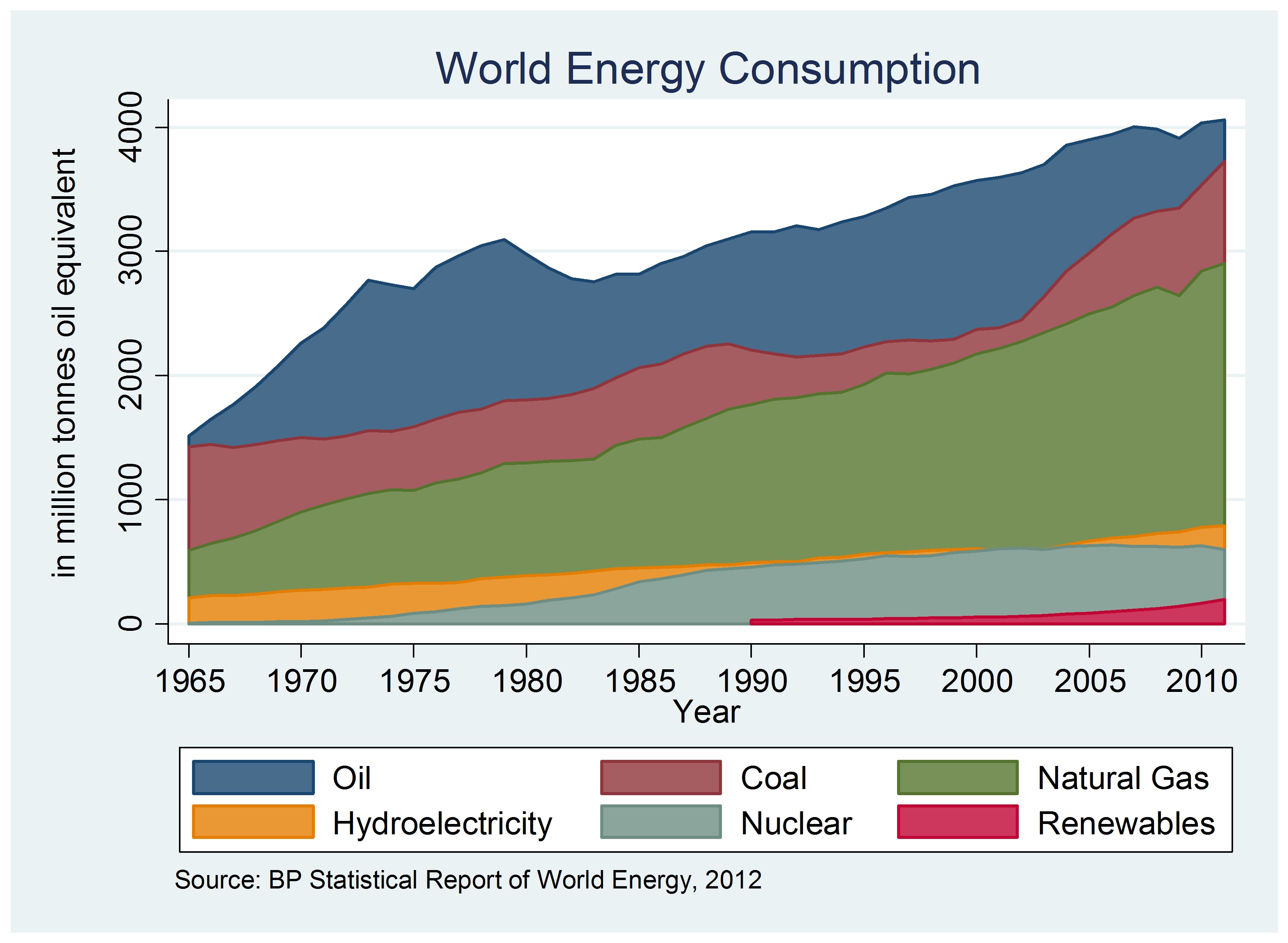
World Energy Consumption


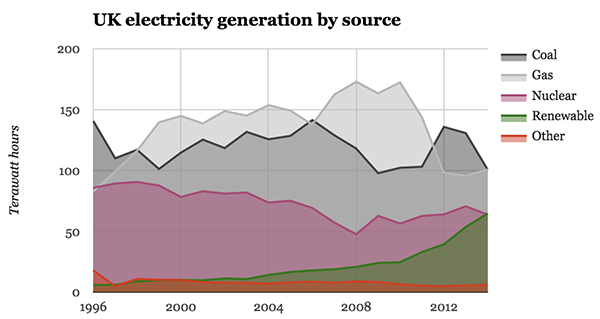
Read the two graphs below and choose one to comment on:


SOURCE: Published in The Economist - January 7th 2016


Jan 3, 2016

Share of UK power mix

Part of each fuel type for the generation of electricity in the UK - 2015


SOURCE:
from Carbon Brief July 2015 based on Decc data
Fuel for UK electricity /


SOURCE:
National Statistics / Electricity: Chapter 5, Digest of United Kingdom Energy Statistics (DUKES) - last update June 2015


The Interactive U.K. Energy Consumption Guide


In 2010, total UK overall primary energy consumption in primary energy terms (i.e. fuels obtained directly from natural sources) was 218.5 million tonnes of oil equivalent, 3 per cent higher than in 2009. However, it should be noted that in 2009 UK primary energy consumption was at its lowest level in the last 20 years as a result of the downturn in the economy.


Dec 15, 2015

What is fracking and why is it controversial?


Drilling companies suggest trillions of cubic feet of shale gas may be recoverable from underneath parts of northern England, through a process known as "fracking".
Hydraulic fracturing, or fracking, is a technique designed to recover gas and oil from shale rock. But how does it work and why is it controversial?
 
What is fracking?
 
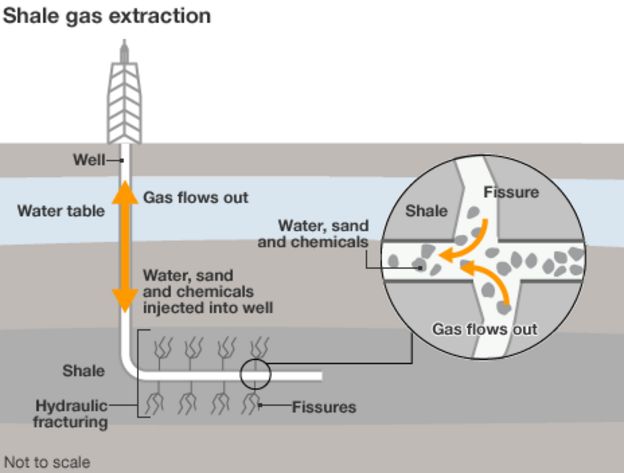
Fracking is the process of drilling down into the earth before a high-pressure water mixture is directed at the rock to release the gas inside. Water, sand and chemicals are injected into the rock at high pressure which allows the gas to flow out to the head of the well.
The process is carried out vertically or, more commonly, by drilling horizontally to the rock layer. The process can create new pathways to release gas or can be used to extend existing channels


Why is it called fracking?
 
It is shorthand for hydraulic fracturing and refers to how the rock is fractured apart by the high pressure mixture. Experts also refer to a "frac job" and a "frac unit".
 
Why is it controversial?
 
The extensive use of fracking in the US, where it has revolutionised the energy industry, has prompted environmental concerns.
The first is that fracking uses huge amounts of water that must be transported to the fracking site, at significant environmental cost. The second is the worry that potentially carcinogenic chemicals used may escape and contaminate groundwater around the fracking site. The industry suggests pollution incidents are the results of bad practice, rather than an inherently risky technique.
There are also worries that the fracking process can cause small earth tremors. Two small earthquakes of 1.5 and 2.2 magnitude hit the Blackpool area in 2011 following fracking.
"It's always recognised as a potential hazard of the technique", says Professor Ernie Rutter from the University of Manchester, "But they're unlikely to be felt by many people and very unlikely to cause any damage."
Finally, environmental campaigners say that fracking is simply distracting energy firms and governments from investing in renewable sources of energy, and encouraging continued reliance on fossil fuels.
"Shale gas is not the solution to the UK's energy challenges," said Friends of the Earth energy campaigner Tony Bosworth. "We need a 21st century energy revolution based on efficiency and renewables, not more fossil fuels that will add to climate change."
 
What are the advantages of fracking?
 
Fracking allows drilling firms to access difficult-to-reach resources of oil and gas. In the US it has significantly boosted domestic oil production and driven down gas prices. It is estimated to have offered gas security to the US and Canada for about 100 years, and has presented an opportunity to generate electricity at half the CO2 emissions of coal.
The industry suggests fracking of shale gas could contribute significantly to the UK's future energy needs. A report by the Energy and Climate Change Committee in April said shale gas in the UK may help to secure energy supplies, but may not bring down gas prices.
 
Where is fracking taking place?
 
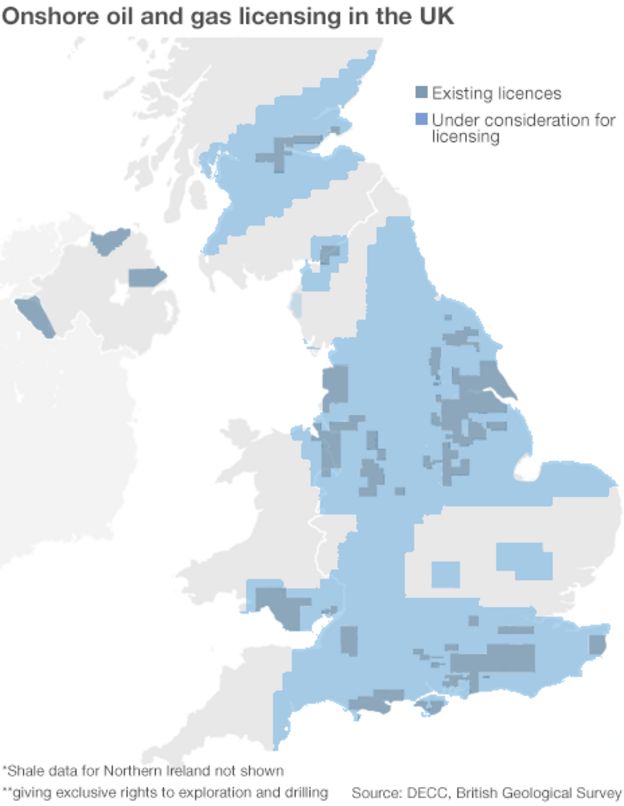
Reserves of shale gas have been identified across swathes of the UK, particularly in the north of England. However no fracking is currently taking place, and drilling firms must apply for a fracking licence if they wish to do so in the future.


Aug 27, 2015

Fracking triggered 2014 earthquake in northeastern B.C.


Quake one of world's largest ever triggered by hydraulic fracturing
By Betsy Trumpener, CBC News
Posted: Aug 26, 2015 6:21 AM PTLast Updated: Aug 27, 2015 8:45 AM PT


Fracking triggered a 4.4-magnitude earthquake in northeastern B.C. last year, CBC News has learned, making it one of world's largest earthquakes ever triggered by the controversial process.
B.C.'s Oil and Gas Commission confirmed the cause of the earthquake in an email statement to CBC this week, saying it was "triggered by fluid injection during hydraulic fracturing."
The 4.4-magnitude quake was felt in Fort St. John and Fort Nelson in August 2014. It was preceded by a 3.8-magnitude earthquake in late July, also caused by fracking.
B.C.'s Oil and Gas Commission told CBC that several companies were doing hydraulic fracturing in the area at the time, and several more were disposing of fracking waste.
But the commission says it was Progress Energy's operations that were "associated with triggering this event."
Hydraulic fracturing, often called fracking, is the process of injecting water, sand and chemicals at high pressure deep underground to break rock and free gas.

Fracking fluid reduced


Since the 2014 earthquake, Progress Energy has been ordered to reduce the volume of fracking fluid being used, and the company has complied, according to the commission.
As well, new seismic equipment has been set up in the area. No new earthquakes have been detected in the immediate area.
Last week, Progress Energy temporarily shut down another fracking site after a 4.6-magnitude earthquake hit just three kilometres away.
Responding to The Canadian Press late Wednesday, Progress Energy said the cause of the recent quake has not yet been established.
"The northeast B.C. foothills is a seismically active area with more than 6,000 seismic events each year, 99 per cent of which measure a magnitude so low that they are not felt on the surface," said a statement from spokesperson Dave Sterna.
The company has voluntarily installed 17 seismic monitoring stations in its operating area, Sterna added.

Officials say it will take several more weeks to determine if the 4.6-magnitude quake was triggered by fracking.

Sign of things to come?


Progress Energy is owned by Petronas of Malaysia, which also owns Pacific NorthWest LNG, the firm planning to build a giant liquefied natural gas export facility near Prince Rupert, B.C. supplied by gas fracked in northeastern B.C.
Matt Horne, with clean energy advocate the Pembina Institute, calls the significant earthquake "another warning sign for what could be down the road.
"If B.C. goes down the LNG road in a big way, it's really important when we're debating LNG proposals, we're eyes wide open.... to both the benefits and impacts. Increased earthquakes is one of those impacts," said Horne.
B.C.'s Oil and Gas Commission declined a taped interview, providing only background information by email.

Minister says events are 'rare'


In a statement, B.C. Minister of Natural Gas Development Rich Coleman said "felt seismic events related to hydraulic fracturing are rare."
"The province has a leading role in North America in the detection and mitigation of induced seismicity associated with unconventional gas development and works closely with the Oil and Gas Commission and industry," the statement said.
The statement went on to emphasize that drilling must stop immediately if "seismicity reaching a magnitude of 4.0 is detected."
"Operations can only resume once a mitigation plan – such as reduced pumping pressures – are agreed on by the Commission," it said.
Peace MLAs Mike Bernier and Pat Pimm didn't respond to requests for comment.
In January, Alberta's energy regulator reported fracking likely caused a 4.4-magnitude earthquake in the northern town of Fox Creek. Scientists told CBC at the time the quake was the largest in the world ever caused by fracking.

Source: http://www.cbc.ca/news/canada/british-columbia/fracking-triggered-2014-earthquake-in-northeastern-b-c-1.3203944


Mar 23, 2015

Britain has the right energy policies in place, it just needs to keep the costs down

Energy and environment policy has rarely been as high-profile as it is now. Decisions taken today will have implications for years to come


Electricity pylon
'Energy and environment policy has rarely been as high-profile as it is now.' Photo: ALAMY
The recent floods and severe weather across Britain have brought the debate around climate change back into sharp focus. While it is not right to attribute individual weather events to changes in the global climate, the storms were consistent with the increasingly volatile and extreme weather patterns predicted by climate scientists.
Later this month the Intergovernmental Panel on Climate Change is due to confirm again that global warming is real and that the costs of containing it will be greater if governments delay taking action.
Meanwhile, unrest in Ukraine also reminds us we should not ignore issues of security of supply.
Successive British Governments have adopted a correct and timely approach to these issues by balancing the need to cut emissions with the desire to ensure we all have affordable and secure energy.
In the next few years, Britain needs more than £100bn of investment in new electricity generation as a quarter of our power stations are phased out or reach the end of their operating lives. The question is whether we replace them with carbon-intensive fossil fuel generation that relies increasingly on imports or with a diverse and secure low carbon energy mix.
Years of informed debate and policy-making in Britain means we have a response that is well thought through and internationally respected. Crucially, the political consensus and stability of these policies have given investors the confidence to put their money into Britain.
The issue of providing secure, affordable, clean energy is common to most European countries. Britain’s policy is in sharp contrast to the German experience: German consumers face some of the highest residential electricity costs in Europe and rising emissions from an increased use of coal and lignite. Investors there are also among the losers.
One of the major planks of Government policy here is called the Carbon Floor Price. This is designed to wean the country off an over-reliance on coal and give a strong incentive to us all to cut greenhouse gas emissions.
The mechanism is simple – by setting a rising price for each tonne of carbon dioxide emitted, it penalises polluters and encourages investment in cleaner forms of power.
When it was launched just three years ago, the Government rightly said this was the most cost-effective way to meet our environmental goals as part of a package of policy measures to drive low-carbon investment.
Two things tell us that the policy is working.
First, it is tipping the balance away from coal to lower carbon gas at a time when many relatively modern gas powered stations have been closed or mothballed.
Second, it is encouraging spending on new low-carbon power generation such as wind, biomass and nuclear to give us a more resilient and balanced energy system.
Industry requires competitive energy costs. Some businesses, especially those in energy-intensive industries, have highlighted the cost of carbon pricing on their international competiveness. It is right that this issue is addressed by targeted and specific measures.
Householders are under pressure, too.
Politicians and energy companies have to work together to bear down on costs of energy efficiency schemes without abandoning important environmental goals or damaging investor confidence.
Action taken last December to review the costs of energy company obligation charges were a step in the right direction and more can be done but, of all the environmental measures, the Carbon Floor Price, among a wider set of policies, is the most cost-effective way to cut emissions.
EDF Energy supports the Government’s decarbonisation targets and, together with many business leaders and the CBI, we back the European Union’s target to reduce greenhouse gas emissions by 40pc by 2030.
We are playing our part in meeting the challenge by investing more than £1bn a year in the UK. That means bringing new gas and wind power on stream. It also means we will ensure our coal stations are available to keep the lights on during this period of transition to a lower carbon energy future.
Last year, EDF Energy and the Government concluded a deal for power from the first new nuclear power station in a generation at Hinkley Point in Somerset. It will be ready just as the first of our existing low-carbon nuclear stations is coming to the end of its life. It will provide a massive boost to the economy and rebuild the British nuclear industry.
As the agreement is part of this far-reaching reform of the UK energy market, it is right that the European Commission should examine the deal.
We are encouraged by the pace of the Commission inquiry. The consultation period will show that the contract for Hinkley Point C is fair and balanced for investors and consumers.
In the meantime, our investments to extend the lives of our 15 existing nuclear reactors by around two years will delay the crunch point when electricity demand and supply converge. This has bought the country some much-needed breathing space but it has not changed the fundamentals.
That’s why the Government must send a strong signal that it remains committed to its long-term energy policies, even if it makes short-term and temporary adjustments to them. Although there may be a short postponement of the energy gap, there is no such respite available on climate change.
Energy and environment policy has rarely been as high-profile as it is now. Decisions taken today will have implications for years to come. We have the right policies in place. Now we must deliver them in the most cost-effective way possible. 

Vincent de Rivaz is the chief executive of EDF Energy 

http://www.telegraph.co.uk/finance/comment/10701663/Britain-has-the-right-energy-policies-in-place-it-just-needs-to-keep-the-costs-down.html

Jan 8, 2015

The Energy Issue - Computer Room Activity


Prepare your presentation about the energy resource given!

Present the energy resource:
-      How does it work (briefly, do not give too many technical details)?
-      Explain where and how it is used, the main production and consumption sites.
Give the advantages and disadvantages of this resource

Explain the trends, problems, developments & projects…linked to it.

Prepare some visuals of your choice to illustrate your speech - pictures/ charts / video / PowerPoint…

Other requirements
All the sources used will have to be mentioned.
Do not read during your presentation but speak clearly!
Check the spelling and pronunciation of the words!
Please, don't read your notes all the time but try to speak!

LINKS:

For every group:
Basic information, advantages and drawbacks for every energy resource:

http://www.smh.com.au/environment/energy-smart


SOLAR POWER


NUCLEAR POWER


BIOFUELS


WINDPOWER


BIOMASS


GAS


COAL


OIL


WAVE, TIDAL AND HYDROPOWER


GEOTHERMAL
COP21 / ENERGY


http://geoeuropeansection.blogspot.fr/2016/01/climate-of-change-cop21.html
http://www.cop21.gouv.fr/en/more-details-about-the-agreement/   


FRACKING / SHALE
LAST UPDATES
 6TH JANUARY 2015
15TH DECEMBER 2015